Recent Edits
This area was badly damaged by the September 2026 storm and is currently closed.
- Aeromarine Industrial Park ( 40.44306, -74.18967 )
- Lake Lefferts - Matawan ( 40.41563, -74.23362 )
- old saltwater pool ( 40.44981, -74.21699 )
- Raritan Bay - Cliffwood (E) ( 40.45089, -74.22033 )
- Raritan Bay - Cliffwood (W) ( 40.45216, -74.22269 )
- Raritan Bay - Cliffwood (Whale Creek) ( 40.45090, -74.22274 )
- Raritan Bay - Keyport (E) ( 40.44095, -74.19534 )
- Raritan Bay - Keyport (W) ( 40.43921, -74.20160 )
- Raritan Bay - Laurence Harbor (E) ( 40.45877, -74.24622 )
- Raritan Bay - Laurence Harbor (W) ( 40.46223, -74.25482 )
- Raritan Bay - South Amboy (N) ( 40.48343, -74.27059 )
- Raritan Bay - South Amboy (S) ( 40.47946, -74.26831 )
- Raritan Bay - South Amboy Ramp ( 40.48401, -74.27416 )
- Raritan Bay - Union Beach (E) ( 40.44787, -74.16598 )
- Raritan Bay - Union Beach (W) ( 40.45479, -74.17517 )
- Superfund Site ( 40.45776, -74.24129 )
- Wagner's Marina - Matawan Creek ( 40.43540, -74.21416 )
The marker in the lower-center of the map is a super-easy put-in on Whale Creek, above. The other markers are a longer slog over the beach. All have convenient free parking (don't leave your vehicle in the launching area, that's a dick move!)
More: Cliffwood Beach - Aberdeen ...
- Hackensack River - Bergenfield ( 40.92835, -74.03023 )
- Hackensack River - Foschini Park ( 40.88477, -74.03524 )
- Hackensack River - Meadowlands ( 40.80747, -74.05723 )
- Hackensack River - Secaucaus (S) ( 40.76390, -74.08685 )
- Hackensack River - Secaucus (N) ( 40.80552, -74.04345 )
- Newark Bay - Bayonne ( 40.66284, -74.13305 )
- Newark Bay - Rutkowski Park ( 40.68882, -74.11216 )
- Overpeck Creek - Teaneck ( 40.86648, -74.00077 )
More: Hackensack River ...
- Aeromarine Industrial Park ( 40.44306, -74.18967 )
- Lake Lefferts - Matawan ( 40.41563, -74.23362 )
- old saltwater pool ( 40.44981, -74.21699 )
- Raritan Bay - Cliffwood (E) ( 40.45089, -74.22033 )
- Raritan Bay - Cliffwood (W) ( 40.45216, -74.22269 )
- Raritan Bay - Cliffwood (Whale Creek) ( 40.45090, -74.22274 )
- Raritan Bay - Keyport (E) ( 40.44095, -74.19534 )
- Raritan Bay - Keyport (W) ( 40.43921, -74.20160 )
- Raritan Bay - Laurence Harbor (E) ( 40.45877, -74.24622 )
- Raritan Bay - Laurence Harbor (W) ( 40.46223, -74.25482 )
- Superfund Site ( 40.45776, -74.24129 )
- Wagner's Marina - Matawan Creek ( 40.43540, -74.21416 )
Lake Lefferts is a man-made lake, the result of the construction in 1928 of Lake Lefferts Dam, which captures and stores the flow of Matawan Creek. This is the nicest spot in northern Monmouth County. The lake is in three parts:
- The lower part that contains the dam and the launch area and extends up to the Route 34 bridge. This part is fairly deep and free of obstructions.
- The upper part from Route 34 to Route 516. This part is much shallower and weedy, especially at the far end.
- An unusable section beyond Route 516. This part is pretty much just mud. It may look like water, but trust me - don't go there.
More: Lake Lefferts - Matawan ...
- Aeromarine Industrial Park ( 40.44306, -74.18967 )
- Lake Lefferts - Matawan ( 40.41563, -74.23362 )
- old saltwater pool ( 40.44981, -74.21699 )
- Raritan Bay - Cliffwood (E) ( 40.45089, -74.22033 )
- Raritan Bay - Cliffwood (W) ( 40.45216, -74.22269 )
- Raritan Bay - Cliffwood (Whale Creek) ( 40.45090, -74.22274 )
- Raritan Bay - Keyport (E) ( 40.44095, -74.19534 )
- Raritan Bay - Keyport (W) ( 40.43921, -74.20160 )
- Raritan Bay - Laurence Harbor (E) ( 40.45877, -74.24622 )
- Raritan Bay - Laurence Harbor (W) ( 40.46223, -74.25482 )
- Raritan Bay - Union Beach (E) ( 40.44787, -74.16598 )
- Raritan Bay - Union Beach (W) ( 40.45479, -74.17517 )
- Superfund Site ( 40.45776, -74.24129 )
- Wagner's Marina - Matawan Creek ( 40.43540, -74.21416 )
This site varies, depending on when you go there. During the summer, and especially on weekends, there can be a lot of motorboats around. Other times, you can have the whole place to yourself.
More: Keyport / Matawan Creek ...
- Orange Reservoir - Rahway River ( 40.75964, -74.28903 )
- Rahway River - Clark ( 40.62884, -74.29746 )
- Rahway River - Cranford (N) ( 40.66036, -74.30627 )
- Rahway River - Cranford (S) ( 40.65097, -74.30133 )
- Rahway River - Cranford (W) ( 40.65900, -74.30997 )
- Rahway River - Jackson's Pond ( 40.62805, -74.28492 )
- Rahway River - Lenape Park ( 40.67407, -74.31426 )
- Rahway River - Mohawk Park ( 40.64041, -74.29408 )
- Rahway River - Nomahegan Lake ( 40.66832, -74.31741 )
- Rahway River - Park ( 40.62040, -74.28944 )
- Rahway River - Rahway ( 40.59952, -74.26856 )
- Rahway River - South Branch (E) ( 40.60010, -74.27397 )
- Rahway River - South Branch (W) ( 40.57998, -74.30463 )
- Rahway River - South Mountain ( 40.73112, -74.30704 )
- Rahway River - Springfield ( 40.70824, -74.30186 )
- Robinson's Branch - Rahway River ( 40.61839, -74.30495 )
The Rahway River rises in Essex County as two separate branches. The West Branch begins at spring-fed Crystal Lake in West Orange and flows south through the South Mountain Reservation in the valley between first and second ridges of the Watchung Mountains. It runs directly through downtown Millburn. The East Branch rises as a surface stream in West Orange and forms part of the boundary between West Orange and Orange, then travels through the towns of South Orange and Maplewood.
The two branches meet at Hobart Gap near Interstate 78, continuing south through the Union County communities of Springfield, Union, Cranford and Clark. In Rahway the river receives the Robinson's Branch and South Branch, which are approximately 10 miles long. The South Branch starts in Roosevelt Park in Edison behind the Menlo Park Mall, and flows through Edison, Iselin, and Rahway. The river's mouth is at the Arthur Kill between Carteret (on the south) and Linden (on the north), opposite Port Mobil on Staten Island.
More: Rahway River ...
- Liberty State Park - Jersey City ( 40.69768, -74.06520 )
Parking and launch access are free. There can be a good deal of boat traffic on the river, especially ferries, but if you are careful, you can paddle around the Statue of Liberty and Ellis Island.
More: Liberty State Park - Jersey City ...
Kayaking is a pretty safe activity in New Jersey. There are no crocodiles or alligators this far north, and dangerous sharks are extremely uncommon. However, there are still a few things you should watch out for.
More: Wildlife Hazards ...
If you've never spent much time on the water, then you probably don't realize just how fast you can get sunburned. That is because you are getting a double dose of the sun - both direct and reflected off the water's surface. You can get burned very fast.
The best protection against the sun is a big broad-brimmed hat (not a baseball cap - that is nearly useless.) If you periodically dunk the hat in the water or wet it from a bottle, it will stay nice and cool.
More: Sunburn ...
This is for sit-on-top kayaks with closed hulls. Open-hull sit-inside kayaks don't really need hatches.
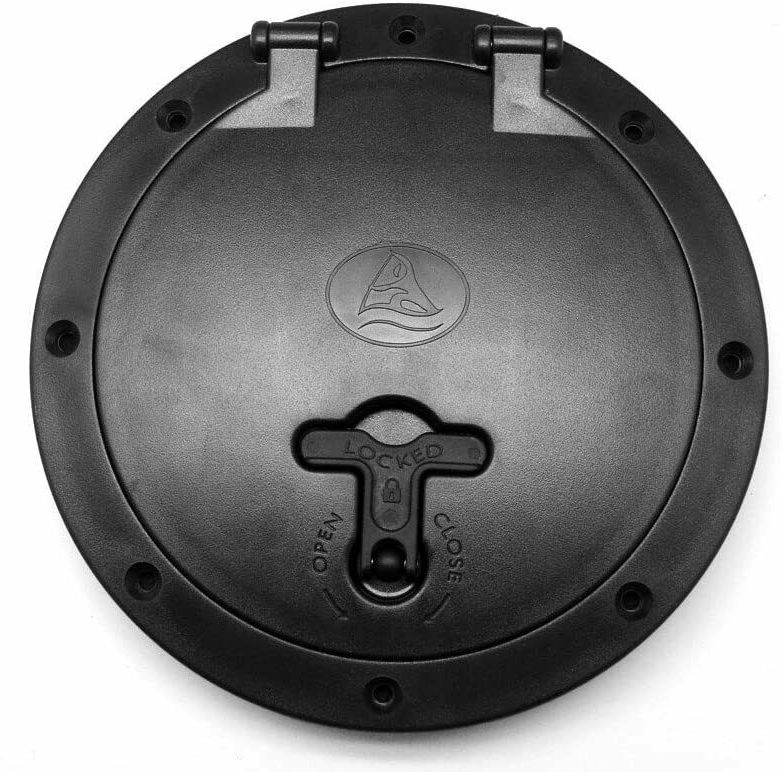
You can order any kind and size of hatch on eBay. They are easy to install - just trace the hole on the hull and cut it out with a jigsaw. A hatch like this one has a storage bag for small items like keys and phone, which removes for access to the inside of the hull.
More: Hatches & Storage ...
Here is a map you can use to see just water features. The level of detail increases as you zoom in. The boundary lines have been deleted, as they often follow and obscure water features. It is interesting to trace the rivers to their headwaters.
In the north, the state's two largest river systems are the Passaic and the Raritan, which intertwine. In the south, the Mullica forms a sizable river system. Only one river originates in New Jersey and leaves the state - the Walkill in the north. All others are captured by either the Delaware or the Hudson, or the extensive southern bays. The orange line is approximately the dividing line between east (Hudson/Atlantic) and west (Delaware River) drainages. The red line is the "fall line" - the boundary between the Piedmont uplands and Atlantic coastal plain. And that's your lesson in hydrology.