Wildlife

Kayaking is an outdoor activity. Yes, kids, you'll have to put down your game controllers and go outside. Out there is what us older folks call nature. Nature can actually be quite beautiful and interesting, and you don't have to worry about your screen resolution and refresh rate - both are infinity. So here is a short list of flora and fauna ( plants and animals ) that you might see in freshwater environments:

Birds

Fishes

Turtles, Frogs & Snakes

Mammals

Bugs

Plants

Salt Water

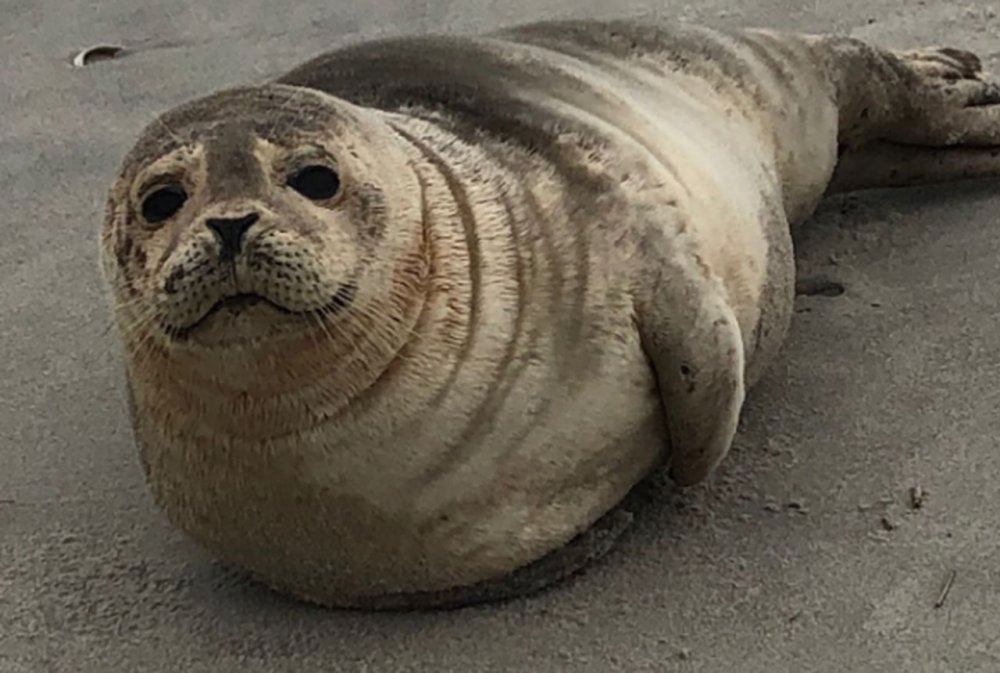
All of the birds listed above can also be found in saltwater environs. The list of saltwater fishes is too long to even start. Insects and amphibians have poor tolerance for saltwater and are not found there, but many other types make up for that. Likewise, seals and dolphins may be found in our bays and inlets.

This is by no means an exhaustive listing, just a few representative types that you are likely to see on almost any trip. I'm going to be lazy here, and filch a lot of material from Wikipedia. I'm keeping this all informal and unscientific; I'm not even going to bother with Latin names. However, if there is something you want to know more about, I will place Wikipedia links.
Muskrat

Muskrats are common across the state. While considerably bigger than plain old rats, they are nowhere near the size of beavers, which can get to 50 pounds. Muskrats have tails that are slightly flattened from side to side, unlike beavers which have broad flat tails. Both animals build conical houses in the water, but only beavers build dams.

-- Wikipedia


White

Water Lilies are found in all still and slow-flowing freshwaters. One thing that I have noticed about them is that on any lake or pond, you will always find white ones, and usually also pink or yellow ones, but never both. The flowers begin in summer and last well into fall.


Orbweavers

Orchard Orbweaver

If you are trying to escape the sun in the shade of overhanging tree branches, you are inevitably going to get spiders in the boat. These are almost entirely harmless orbweavers - they are not aggressive and don't bite, and are not poisonous to humans, at least no more poisonous than a honey bee. That said, our brains are programmed at the most basic level to fear spiders, and I don't like them any more than anyone else. Just calmly knock it out of the boat.


Algae

Yuck!

Unlike marine algae, freshwater algae is usually little more than green slime. Much of it is actually microscopic single-celled organisms that form the base of the food chain. That is why the water is green ( when it is green. ) *


Clinging jellyfish are shown swimming in a jar in 2016. The small jellies can pack a dangerously powerful sting. Tanya Breen/staff Photographer

Amanda Oglesby
Asbury Park Press
June 19, 2026

BRICK - A surge of clinging jellyfish are infiltrating the Metedeconk River, where a 6-year old child has already suffered a severe string, said New Jersey's leading expert on jellyfish.

Paul Bologna, the director of Montclair University's Marine Biology and Coastal Sciences Program, said the river's north bank has "a huge number of these clinging jellies." These coin-sized translucent jellyfish cling to sea lettuce and filamentous red algae common in the Jersey Shore's coastal rivers and estuaries, he said.

"Their tentacles have special adhesive pads that ... suction cup themselves onto that stuff," Bologna said.

Despite their small size, the clinging jellyfish pack a dangerously powerful sting, one that can lead to days-long hospitalizations, the biologist said.